Green, Gold, Diamond, Platinum, Rhodium etc
Navigating modern publishing business models
Grenoble, 22 January 2026
Jean-Sébastien Caux
Institute of Physics
University of Amsterdam

Institute of Physics
University of Amsterdam
What is Open Access (OA) anyway?
For the last ~25 years, an international movement to enable free, open and permanent online access to scholarly outputs (publications, datasets, etc)
What is Open Access (OA) anyway?
A publication (or other output) is open access if:
- there are no financial, legal or technical barriers to accessing it
- anyone can download, read, print, copy, reuse, redistribute it
- these rights being encoded in an appropriate license (typically a Creative Commons (CC) one)
What are the main OA types?
- Green
- Gold
- Hybrid
- Diamond
Green OA
- paper published "as usual" in non-OA journal
- full text (preprint, or accepted version) deposited in repository
- Example: arXiv
- only addresses the "accessibility" problem
- leaves traditional publishing unreformed
Gold OA
- publication in fully open access journal
- typically involves charge to authors
- Example: PRX
- the infamous APC (Article Processing Charge)
- costs explosion
- direct dilapidation of research funds (instead of traditional library budgets)
Hybrid OA
- publication in hybrid journals: subscription-based, but allow individual articles to be OA provided an APC is paid
- Examples: Phys Rev, Nature, etc
- infamous for "double dipping" malpractice
- half-baked, "kick can down road" solution
- ineffective "transformative agreements"
Diamond OA
- publication in fully open access journal
- no charge to authors
- Example: SciPost
- requires a new way of thinking about the "business" of publishing
- the only "correct" solution, but...
- insufficiently supported by academic institutions
The trouble with OA
(as it is today)
- it is not implemented widely enough
- the "academic admin" side has been completely outsmarted
- it has enabled legacy publishers to make yet more money
- good intentions have paved a new hell
- researchers are collateral damage
OA: A Failed Revolution?
Endless talking over Open Access,
but not much effective action
What does Diamond mean anyway?
- Small scholar-run operation publishing 5 papers a year and not knowing how to deposit a DOI
- ...
- Large-scale not-for-profit independent publisher operated by professional academics, offering fully professional quality services
- lack of uniformity → 😕
SciPost
What is it? |
A complete publishing portal
|
Who runs it? |
Professional scientists
(is and will remain grassroots)
|
Summary? |
|
What does it aim to achieve?
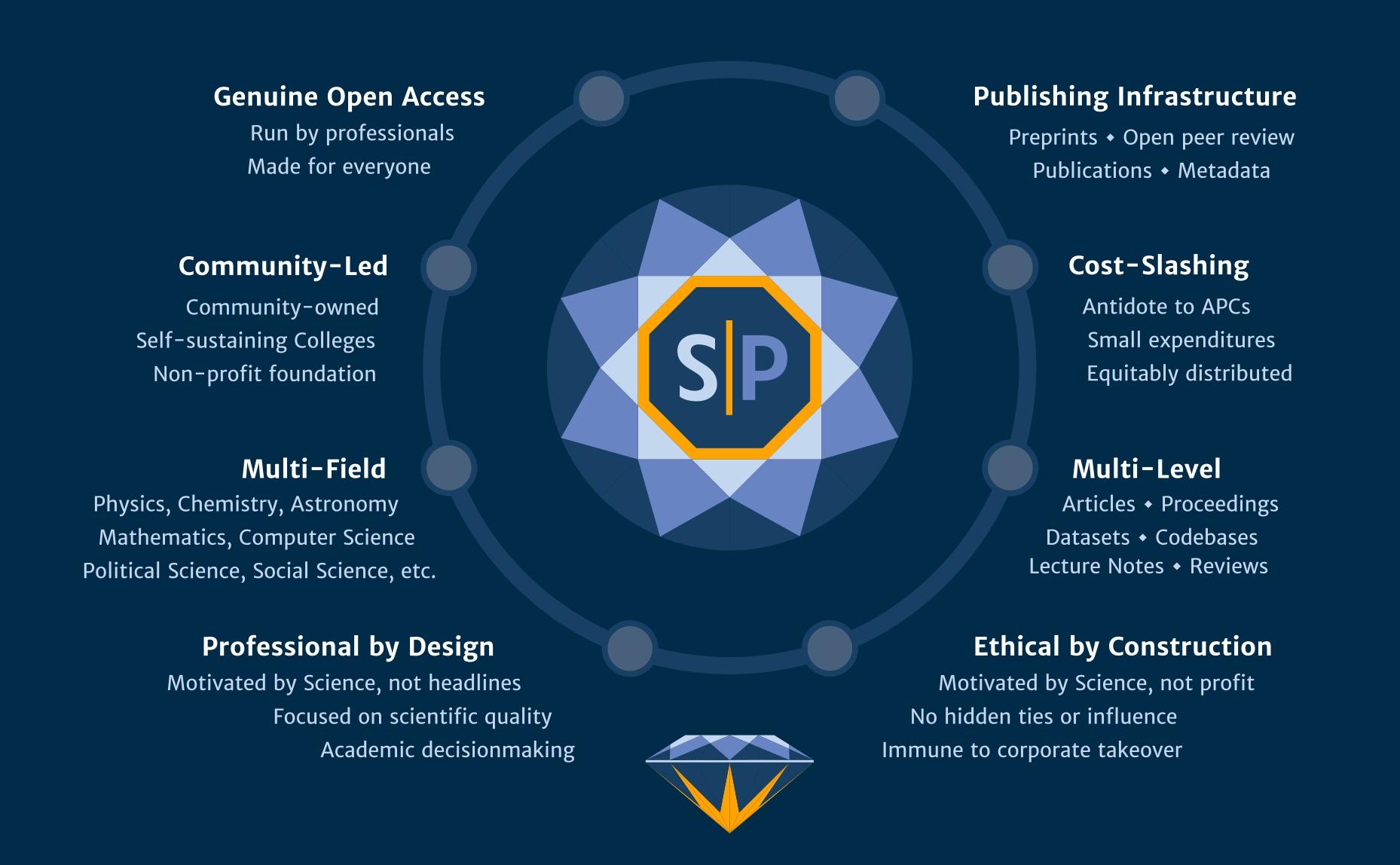
A complete reform of publishing at all levels
-
Implement Genuine Open Access
two-way: free for readers, free for authors -
Implement a healthier business model
- strict editorial/financial decoupling
- no profit-making on the back of scientists
- consortial model; not based on APCs
-
Modernize the refereeing procedure
- open; more credit to referees
- streamline post-publication feedback
- Reform impact assessment
Journals
- SciPost Physics
- SciPost Physics Core
- SP Lecture Notes
- SP Proceedings
- SP Codebases
- SP Comm. Rep.
- ...
~3500 publications
(up to now)
The 3 Pillars
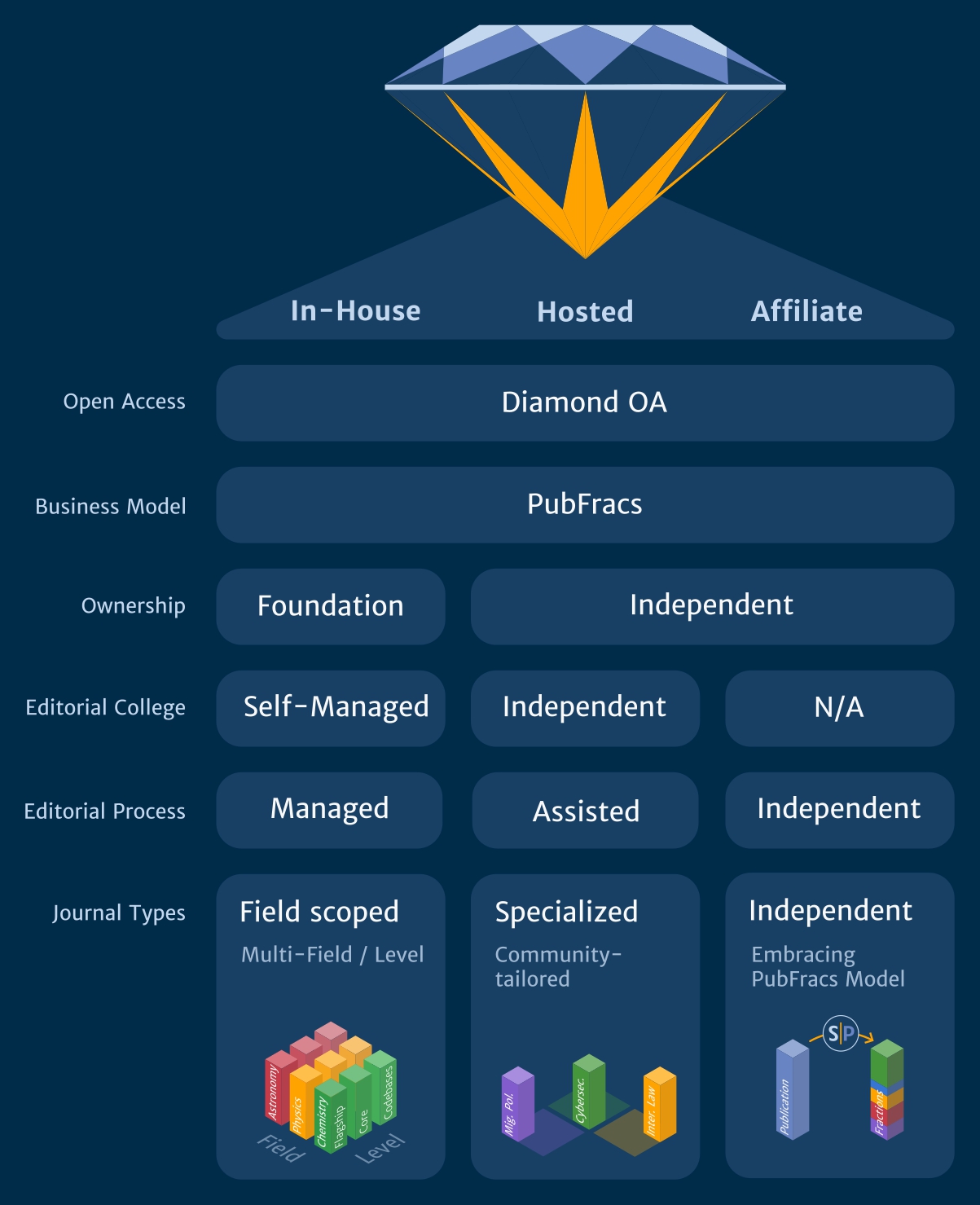
Robert-Jan Smits @ KNAW
Dec. 2018
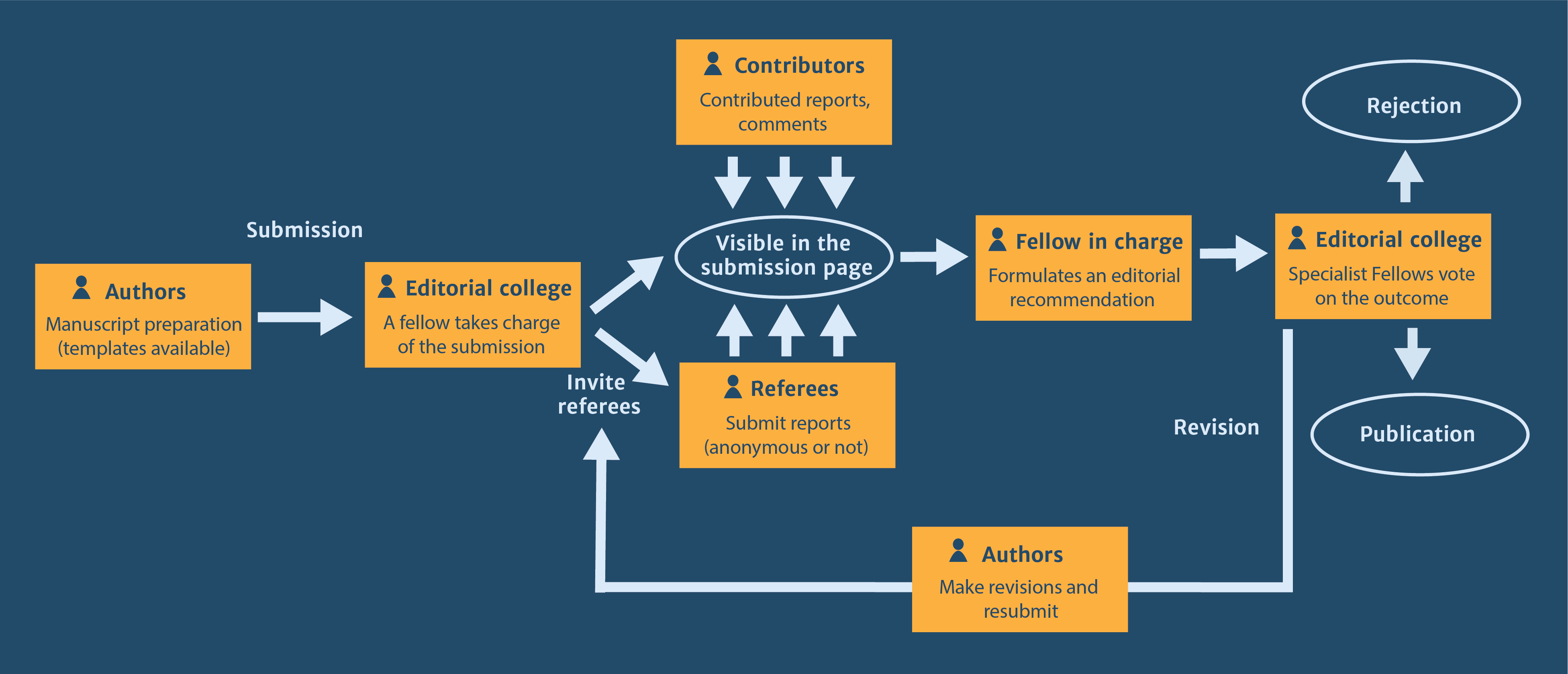
Editorial workflow
Our business model
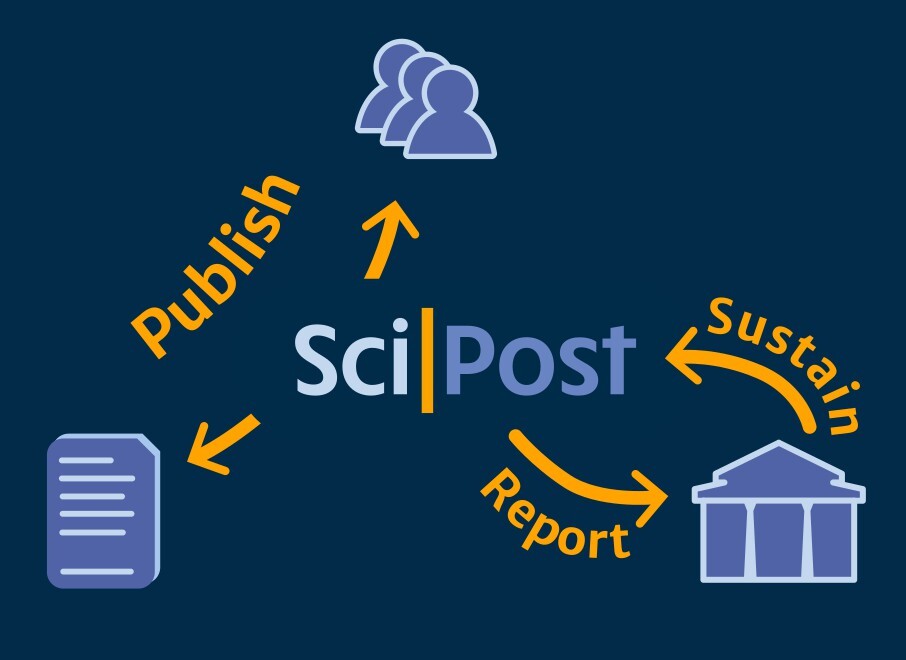
Our business model
The 3 key concepts
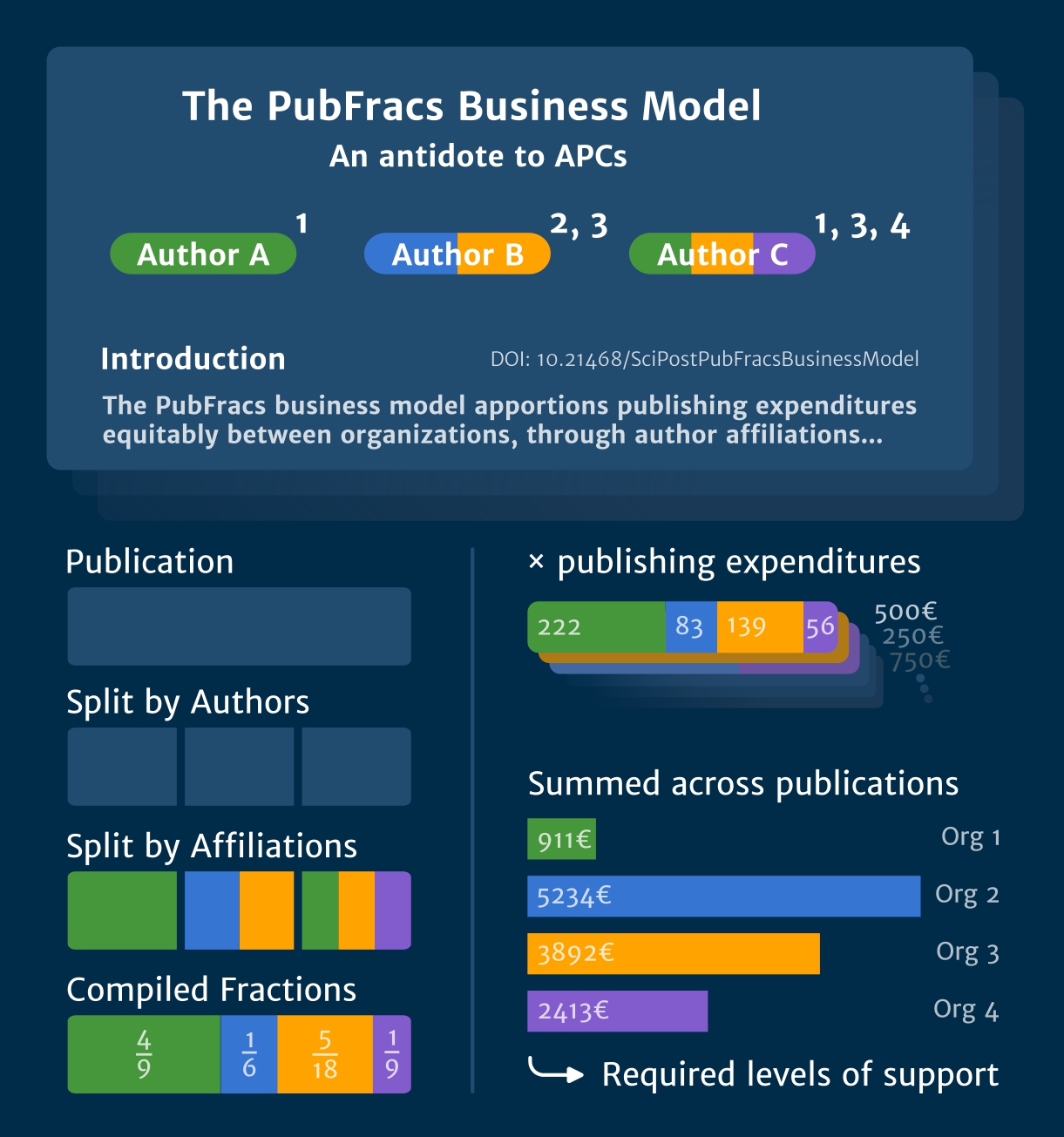
- PubFracs 🠈 ++important!
-
NAP
("Number of Associated Publications") -
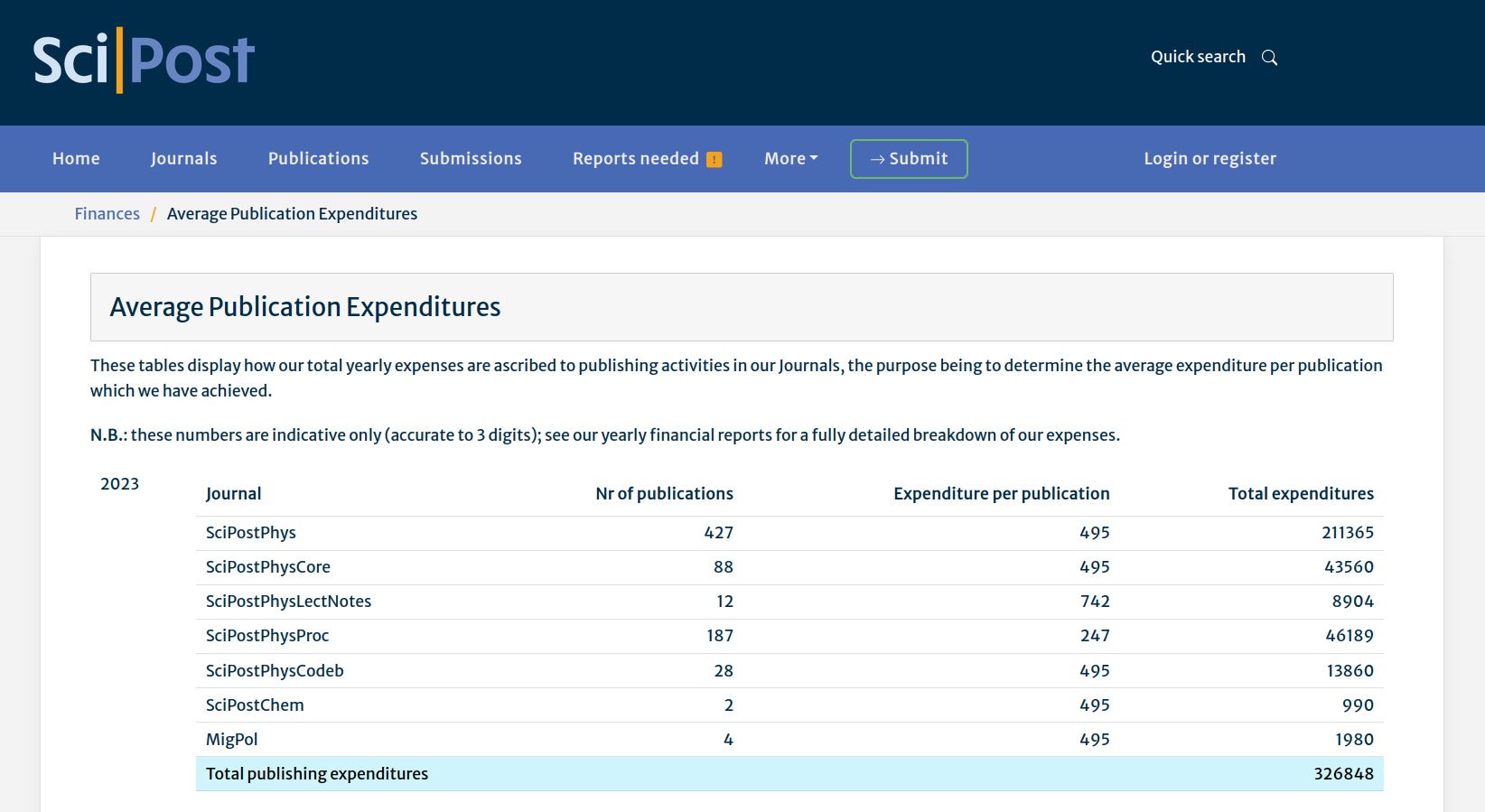
APEX
Average Publication EXpenditures
APEX
\[
\mbox{APEX} = \frac{\mbox{€ operations}}{\#~~\mbox{publications}}
\]
Defined per Journal, per year
APEX
NAP
\[
\mbox{NAP} = \#~~\mbox{publications linked to an Org}
\]
"linked": affiliation, grant etc.
Defined per Org
PubFracs
Data accessibility
Organizations list page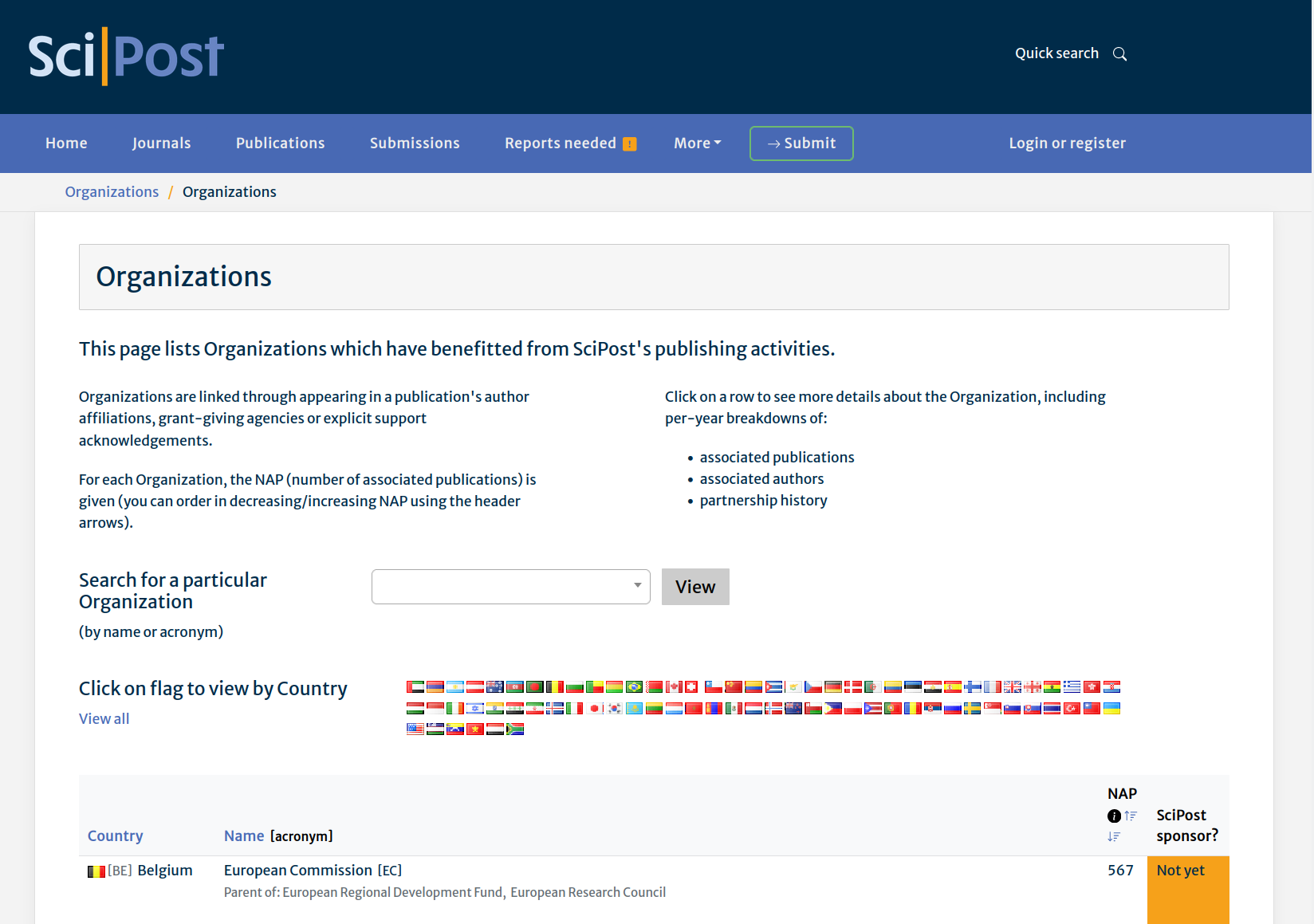
Organization detail page (1/3)
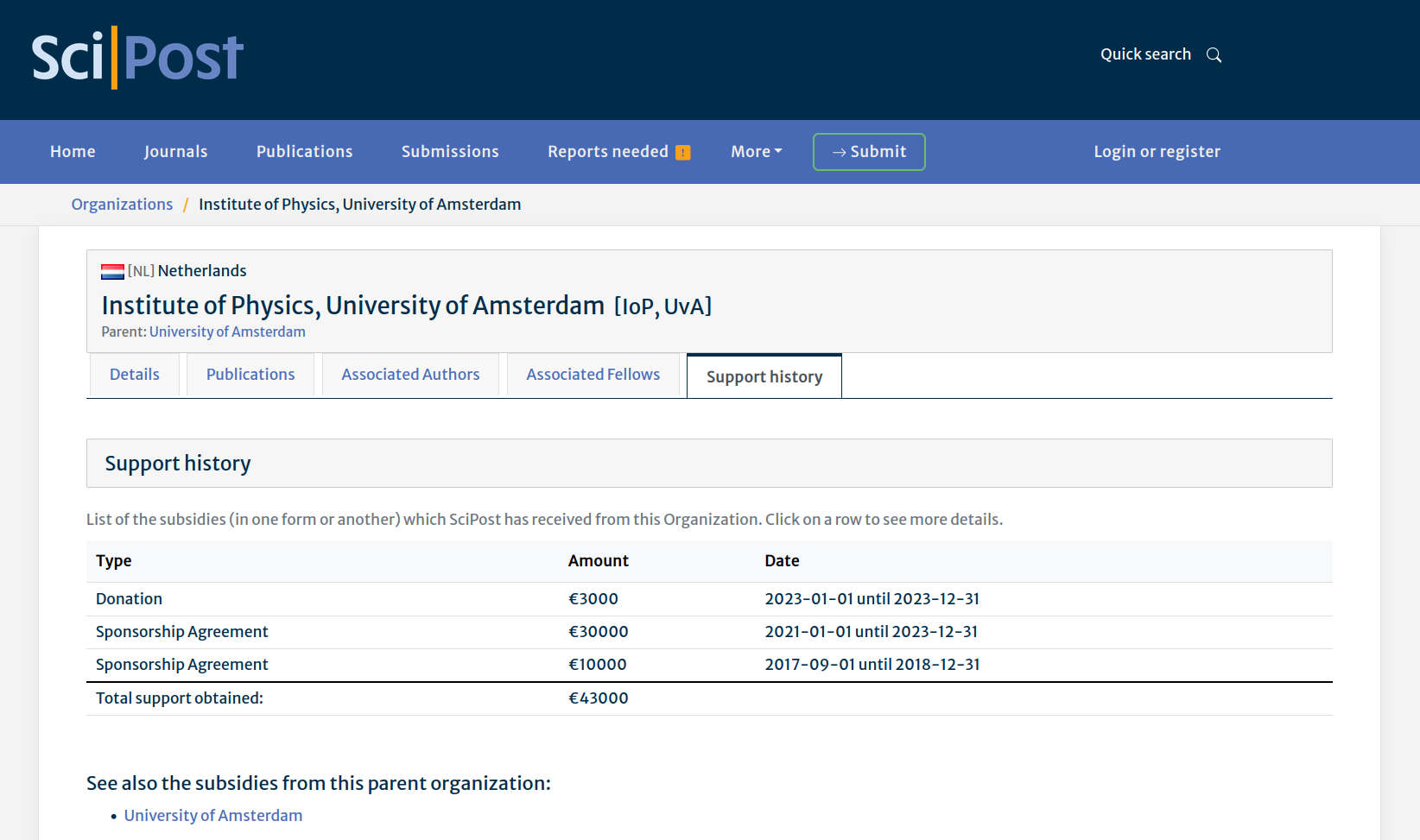
Organization detail page (2/3)
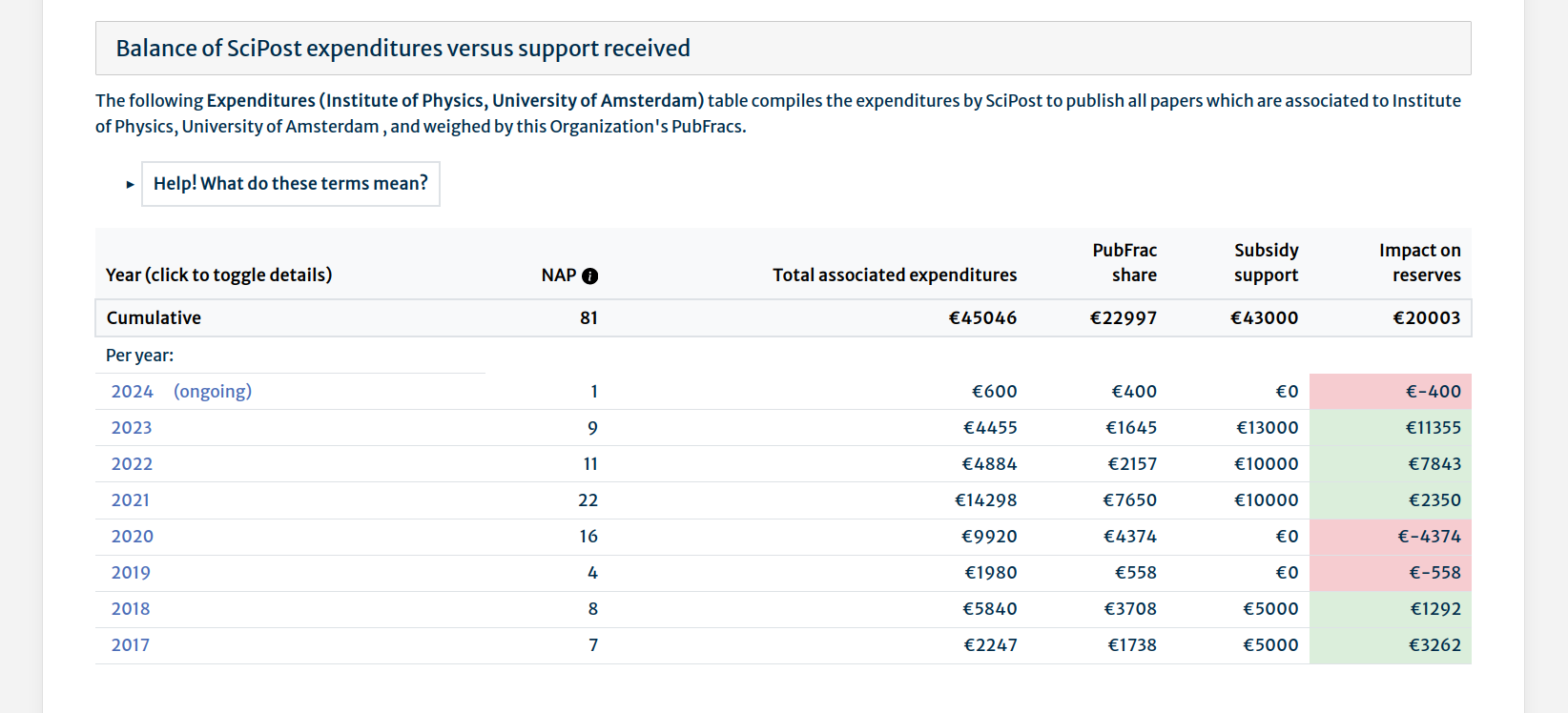
Organization detail page (3/3)
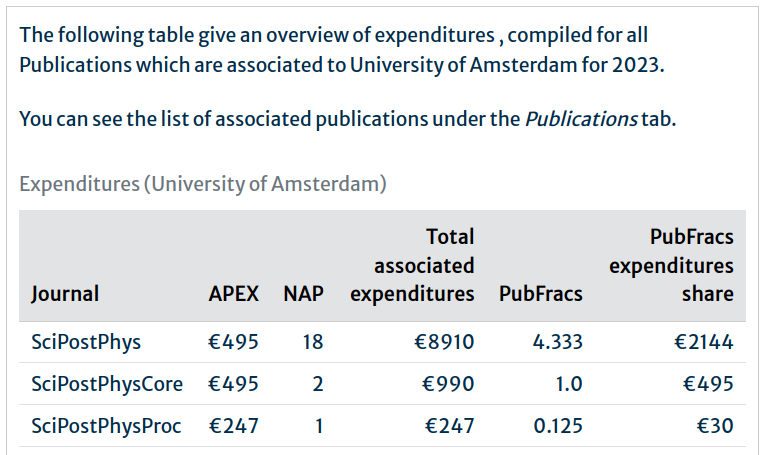
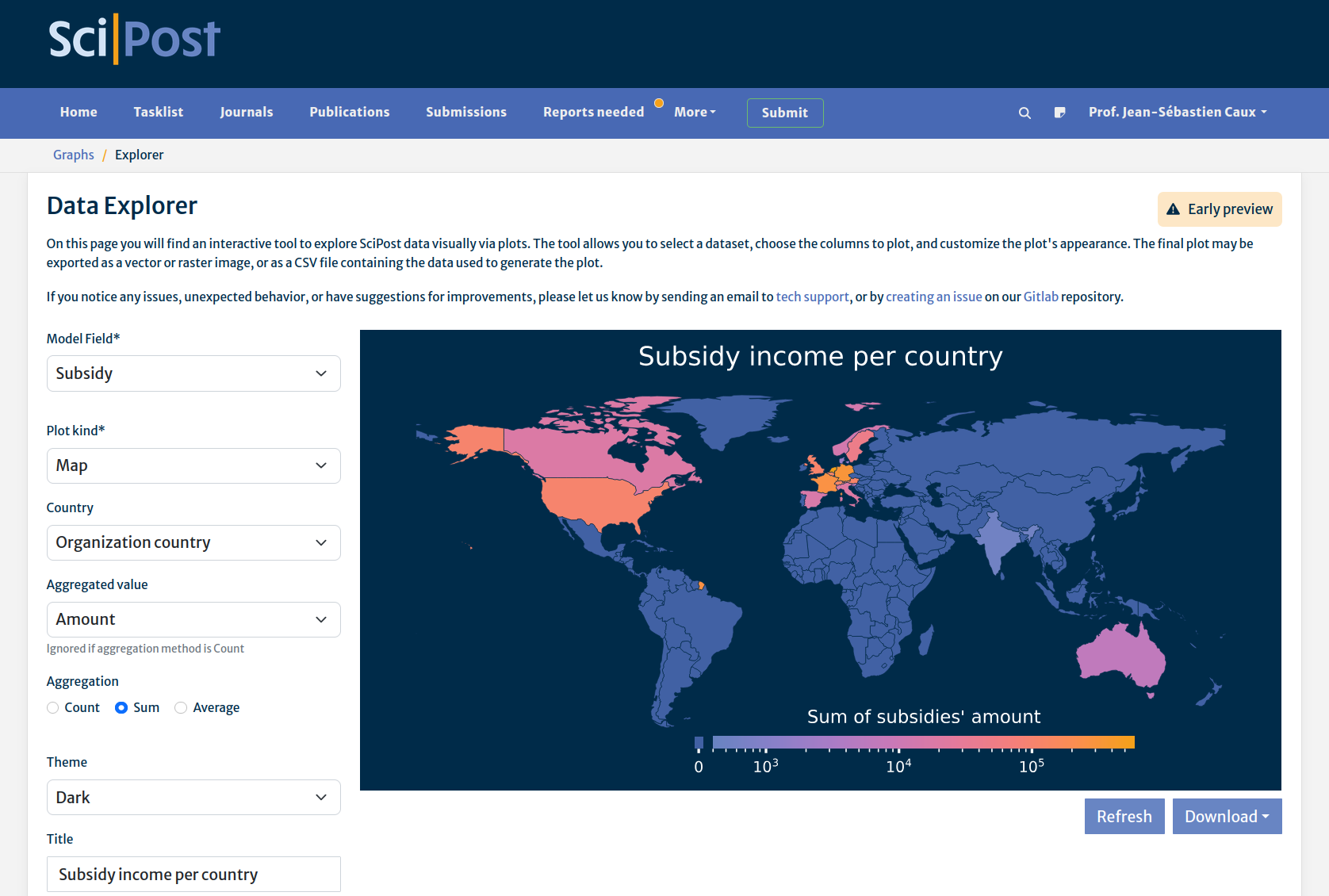
Country-level data
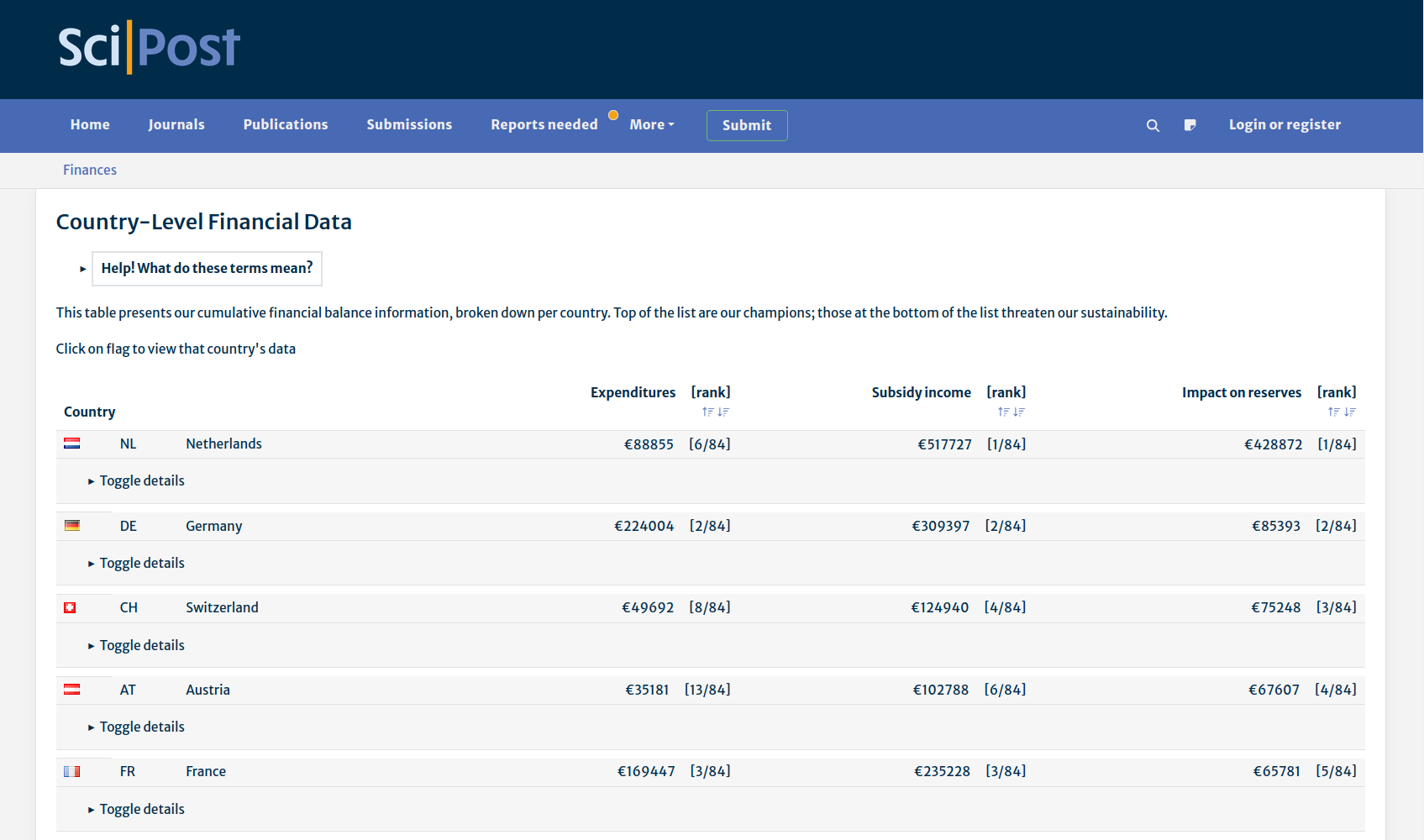
Visualization tools
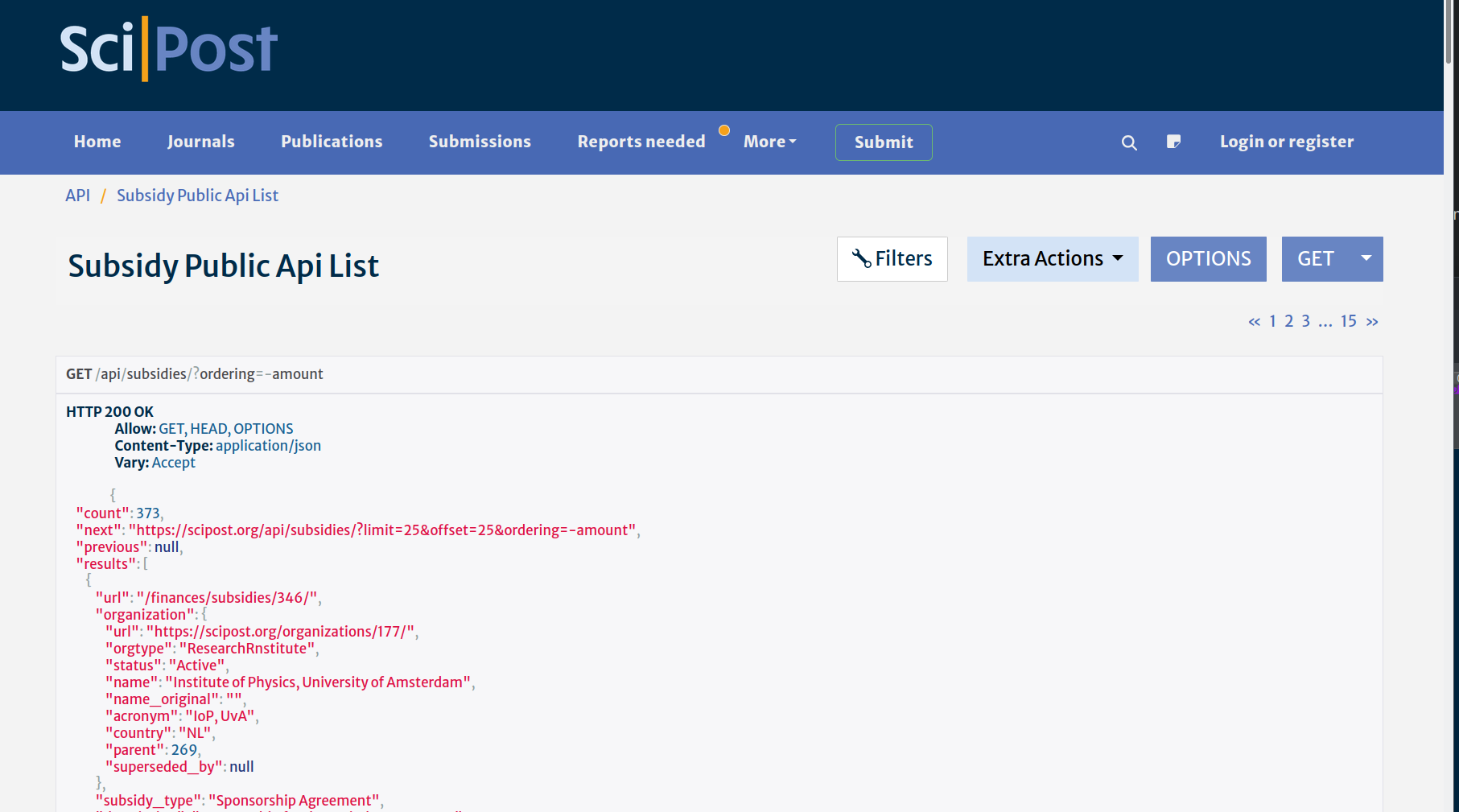
API
Finances
All our financial info:
scipost.org/finances/
Sponsors
Current list:
scipost.org/sponsors/
Avantages of PubFracs
- Equity, in depth
- Ultra-simple accounting
- Total transparency
- Authors not held hostage
- Researchers don't dilapidate their budgets on APCs
- No more wasted time/money in "negotiations"
Disadvantages (1)
- Based on past realizations
🠊 suffocated growth - Non-obligatory support
🠊 insufficient participation (9% !!) - Unfamiliar; ≠ subscriptions, APC 🔫
- Does not "fit" in traditional budgets
🠊 "no money for this" too often heard - Risks: all carried by SciPost
Disadvantages (2)
- Invisible (1): an APC which does not exist is less visible than one which you are billed for
- Invisible (2): no need for a "transformative agreement" means we are easily forgotten
- As on social media, the "problem cases" monopolize all the attention;
SciPost is however not a problem (for you), which represents a problem for us
The reality on the ground
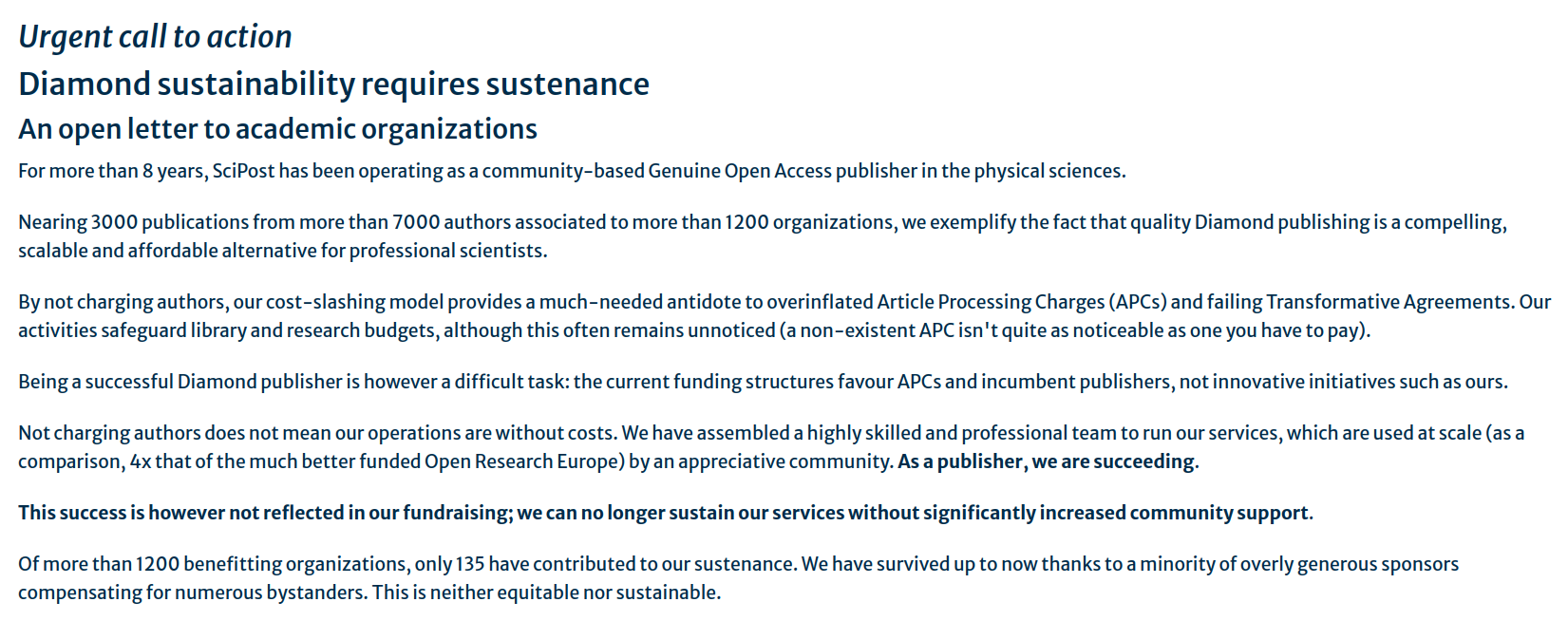
- No security, bankruptcy always within sight
- We have however survived for 10 years...
- ... thanks to a minority of generous organizations
- ... and perhaps a lot of stubbornness on our side.
- Financing: too much work, too unpredictable
- War against APCs: hope fading away fast
- Insufficient/incorrectly distributed structural help/investment from topmost levels
Current situation
Current situation
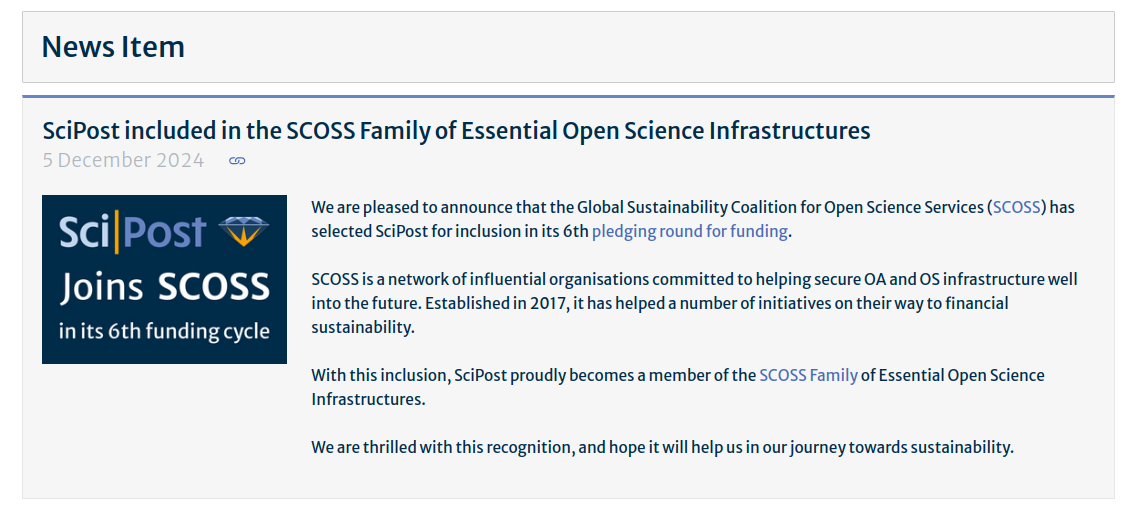
Inclusion in SCOSS
SciPost at a crossroads
Doubling Down on Diamond
The SciPost Team
| J-S Caux | Founder Chairman Developer |
| Joost van Mameren | Secretary |
| Jasper van Wezel | Treasurer |
| Sergio E. Tapias Arze | Executive Director |
| Francesca Ferrari | Editorial Admin |
| George Katsikas | Developer |
| Kyros Megalos Adam | Production |